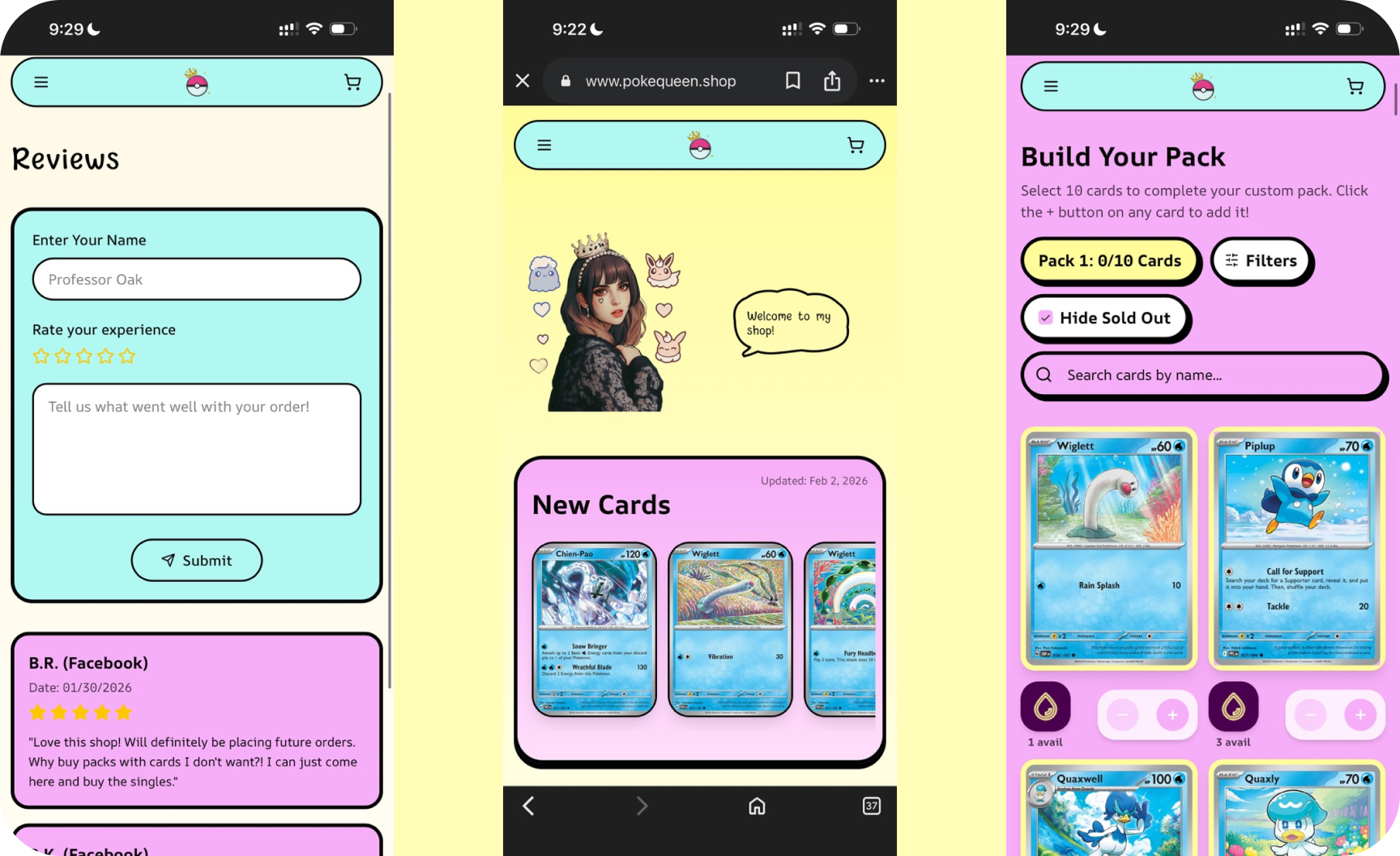

Poké Queen Shop
E-commerce platform designed for micro-businesses
Solving for: small businesses and solo ventures
Problem
E-commerce platforms like Shopify are economically unsustainable for micro sellers whose monthly revenue may be lower than platform fees.
My role
Product Designer and Developer
What I built
A zero platform fee e-commerce system optimized for Pokémon collectors, with custom metadata, automated inventory ingestion, and streamlined shipping.
Outcomes
- $260 revenue in month one
- 96% revenue retained
- Inventory time reduced from ~10 minutes per card to ~30 seconds
- Projected savings of $700–950 per year vs. Shopify
Design Goals
- Zero Platform Fees
- Collector Information Hierarchy
- Operational Efficiency
- Trust Signals
Brand Discovery
Based on what I've seen on Facebook and other major platforms, Pokémon collectors are typically buying their cards from eBay, TCGPlayer, Mercari and Shopify stores
Unfortunately, these platforms don't serve small-scale collectors who want a branded experience with proper card metadata at sustainable economics.
How collectors evaluate cards
Through my own experience (25+ years collecting), I mapped the decision hierarchy:
Information Architecture
Card Data Model
Type Iconography
Instead of text labels ("Fire," "Water," "Psychic"), I used the official Pokémon type icons. Collectors recognize these instantly through a shared visual language that reduces cognitive load when scanning 100+ cards.
Holo Differentiation
Most platforms treat holos as a binary (yes/no). But collectors know Reverse Holos and Masterball Holos have different values and appeal. I built explicit variant tracking into both the database and UI.
Pack Progress Tracking
I sell curated packs (sets of related cards). A progress bar component shows how close each pack is to selling out, with a sidecar displaying remaining cards.
This does two things:
- Gamifies the experience (completion motivation)
- Creates urgency without fake scarcity
Mobile First Layout
Collectors browse on their phones. Card grids adapt to thumb-friendly tap targets, filters collapse into accessible sheets, and card details open in modals rather than new pages.
Custom E-commerce Store
View LiveOperational Design
The Inventory Pipeline
Listing 300+ cards manually would take forever. I designed a workflow:
- Photograph cards in Collectr app (auto-detects card data via image recognition)
- Export to CSV with all metadata populated
- Run import script to batch-upload to Supabase database
Result: ~30 seconds per card vs. ~10 minutes manual entry. The unsexy work that makes the whole thing sustainable.
Shipping Integration
Shippo API generates labels automatically from order data. No copy-pasting addresses or manual carrier selection.
Order comes in → label ready to print.
Build Investment
15 hours to design and ship a complete e-commerce experience.
At $260 revenue in month one: $17.33 per hour invested, and that compounds every month after.
Projected annual savings vs. Shopify: $700-950/year
For a micro-business, that's the margin between profitable and not. 💅🏽